
Research Description
The Hoover Lab aims to elucidate the mechanisms of transition metal catalyzed organic transformations in order to understand and improve upon reactions relevant to current societal challenges, in particular those related to health, energy, and the environment.
Catalytic methods have widespread applications ranging from the large scale synthesis of commodity chemicals to the fine chemical and pharmaceutical industries. Many of today's societal challenges, including those related to health, energy, and the environment, will be solved with with catalytic strategies. Solutions to these challenges require a fundamental understanding of the catalysts and their mechanisms. In the Hoover Group, we map the mechanisms of organic transformations catalyzed by transition-metal complexes. We are particularly interested in catalytic redox reactions in which bond-breaking and -forming steps occur along with oxidation or reduction steps. We develop new organic reactions, synthesize and characterize organometallic intermediates, and measure reaction kinetics. Researchers in our group are trained in synthetic organic techniques, organometallic synthesis, homogeneous catalysis, spectroscopy, and kinetics.
Current areas of interest include:
- Understanding Metal-Mediated Decarboxylation Reactions
- Oxidative Decarboxylative Arylation Reactions
- Oxidative Decarboxylative Amination Reactions
- Cobalt-Catalyzed Aerobic Oxidation Reactions

Understanding Metal-Mediated Decarboxylation Reactions

Key Publications
Field Effects Govern the Decarboxylation of Copper(II)-Benzoates: Kinetic and Mechanistic Studies
Shannen C. Lorraine, Andreas Baur, Natalie Taylor, Brian S. Dolinar and Jessica M. Hoover
Organometallics 2026, 45, 169-180.
Robert A. Crovak and Jessica M. Hoover
J. Am. Chem. Soc.
2018 ,
140 , 2434-2437.
A decarboxylation reaction of carboxylic acids allows us to use benzoic acids as coupling partners to generate more complex products through coupling reactions. This strategy has many advantages since benzoic acids are cheaper and more stable than typical organometallic coupling partners. There are some challenges, however, and decarboxylation reactions are often limited to specific classes of benzoic acids, such as ortho-nitrobenzoic acids or perflurobenzoic acids. Our most recent work in this area has uncovered the origin of this ‘ortho-nitro effect’ and shown that the rates of decarboxylation correlate with the field effect (F), a proximity polar effect of the benzoate substituents.
Our ongoing work is focused on identifying and understanding the underlying structural and electronic features that comprise the field effect. Our approach involves the systematic investigation of a broad array of nitro-substituted silver- and copper-carboxylates to understand how carboxylate features, such as aromaticity and structural flexibility, influence decarboxylation. Our long-term goal in this area is to move away from substrate-based control and toward the design of catalysts that promote reactivity through ligand-based field effects, overcoming the existing limitations in the field.
Oxidative Decarboxylative Arylation Reactions
The decarboxylative coupling of benzoic acids with arene C-H bonds would provide an efficient route to biaryl and heterobiaryl products. We have developed several oxidative decarboxylative arylation reactions using either copper or nickel catalysts. Most recently, we have developed a new nickel-catalyzed decarboxylative arylation reaction that is capable of overcoming the traditional ‘ortho-nitro’ limitations and now enables the efficient coupling of a large scope of heteroaromatic carboxylates.

Key Publications
A Redox Transmetalation Step in Nickel-Catalyzed C-C Coupling Reactions
Kerry-Ann Green, Aaron P. Honeycutt, Sierra Ciccone, Kyle A. Grice, Jeffrey L. Petersen and Jessica M. Hoover
ACS Catal. 2023, 13, 6375-6381.
Aaron P. Honeycutt and Jessica M. Hoover
Org. Lett. 2018 , 20 , 7216-7219.
Aaron P. Honeycutt and Jessica M. Hoover
ACS Catal.
2017, 7, 4597-4601.
Oxidative Decarboxylative Amination Reactions
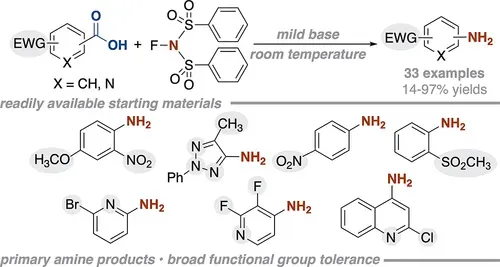
The decarboxylative coupling of benzoic acids with amines would provide an efficient route to aniline and heteroaryl amine products. Primary anilines are important substructures found in pharmaceuticals, agrochemicals, and functional materials, and also serve as important building blocks in synthesis. Unfortunately, current methods for their preparation often require specialized catalysts or hazardous reagents. We have recently developed a new decarboxylative amination reaction that uses a commercially-available electrophilic amination agent, NFSI, as both the amine source and the oxidant to generate primary amines directly in a single step. Our new reaction offers a direct route to anilines that avoids the need for specialized catalysts, prefunctionalized starting materials and commonly employed hazardous reagents enabling more rapid and efficient access to these key scaffolds in synthesis.
Cobalt Catalyzed Aerobic Oxidation Reactions
We are also developing new cobalt-catalyzed reactions that utilize air (oxygen) as the terminal oxidant. In many cases, simple cobalt salts alone aren’t capable of efficiently using oxygen for the selective oxidation of organic molecules. Instead, redox mediators are often needed. We have found that aminophenols and related compounds are able to act as both redox mediator and coupling partner to enable new Co-catalyzed aerobic transformations. Most recently, we have reported the oxidative cyclization of aminophenols with isontriles to generate substituted benzoxazole products.

Key Publications
Aerobic Oxidation Reactivity of Well-Defined Cobalt(II) and Cobalt(III) Aminophenol Complexes
Jiaqi Liu, Shannen C. Lorraine, Brian S. Dolinar and Jessica M. Hoover
Inorg. Chem. 2022, 61, 6008-6016.
Jiaqi Liu, Sarah Morgan, and Jessica M. Hoover
ChemCatChem 2020, 12, 1297-1301.
Jiaqi Liu, and Jessica M. Hoover
Org. Lett.
2019 ,
21 , 4510-4514.